
LOGISTICS TECH STANDARD
LTS builds Korean standard technology that serves as a global benchmark in the logistics industry
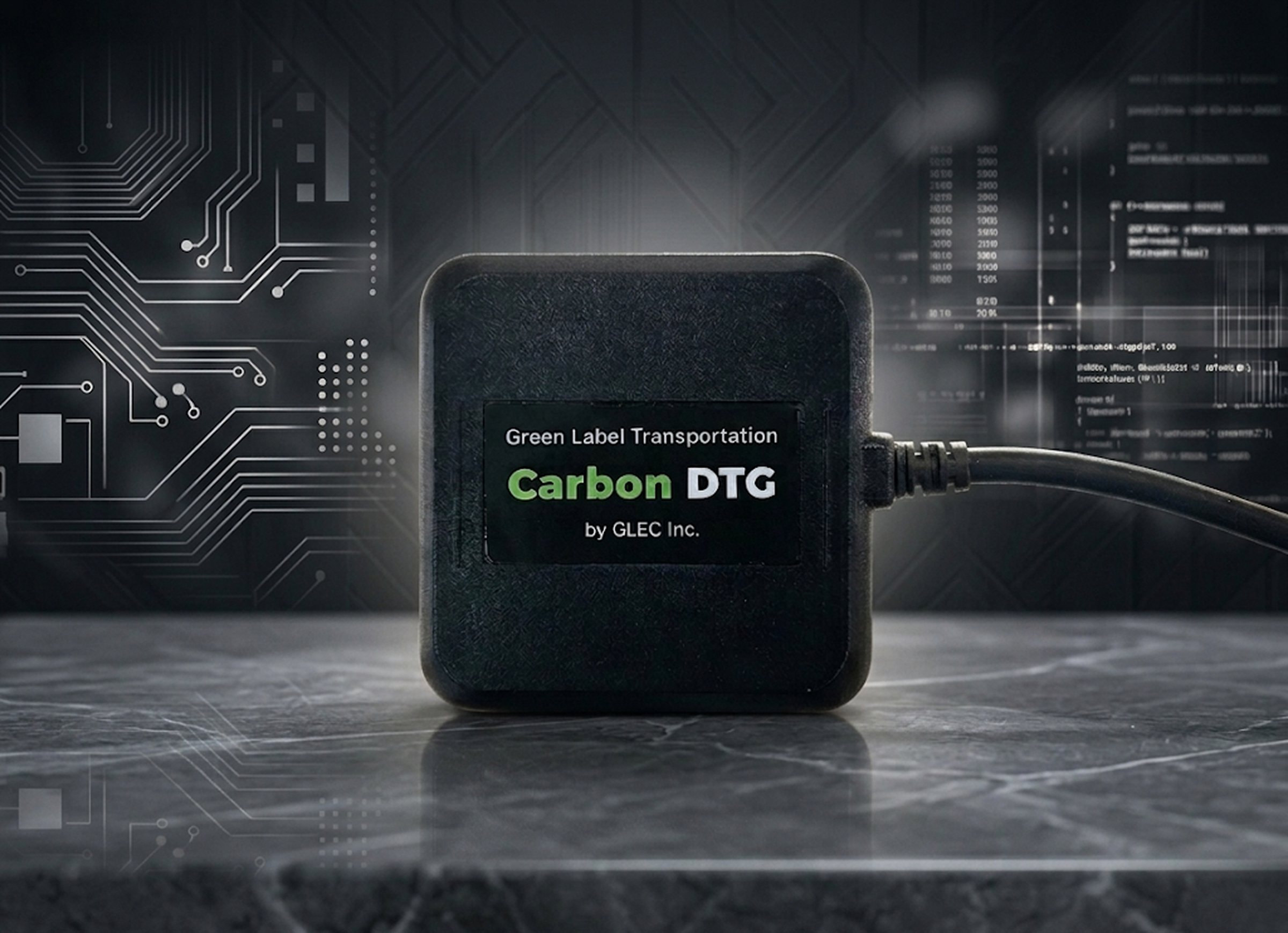
Logistics Tech Standard Co., Ltd. (LTS) supplies AX and GX infrastructure products that measure vehicle trip data with a legally mandated in-vehicle IoT device, run determination with LAS, and supply the results to both carbon and safety work. The company was known as GLEC until it changed its name in June 2026.
Company film
Meet LTS on film
Business
With LTS DTG and two engines, LTS handlescollection, determination and calculation of transport data
LTS DTGIn-vehicle IoT device
Replaces the trip recorder required under the Traffic Safety Act and collects trip data.
LAS engineAI determination of transport data
Maps orders to dispatches and determines which primary contractor receives the transport data.
LCS engineCarbon calculation · ISO 14083 · GLEC Framework
LTS Cloud uses the LCS engine to calculate per-cargo emissions under ISO 14083 and the GLEC Framework.
Recognition and certification
LTS technology is recognized by a government commendation,international certification and awards
LTS (then GLEC Inc.) received a commendation from the Minister of Land, Infrastructure and Transport on the 33rd Logistics Day.
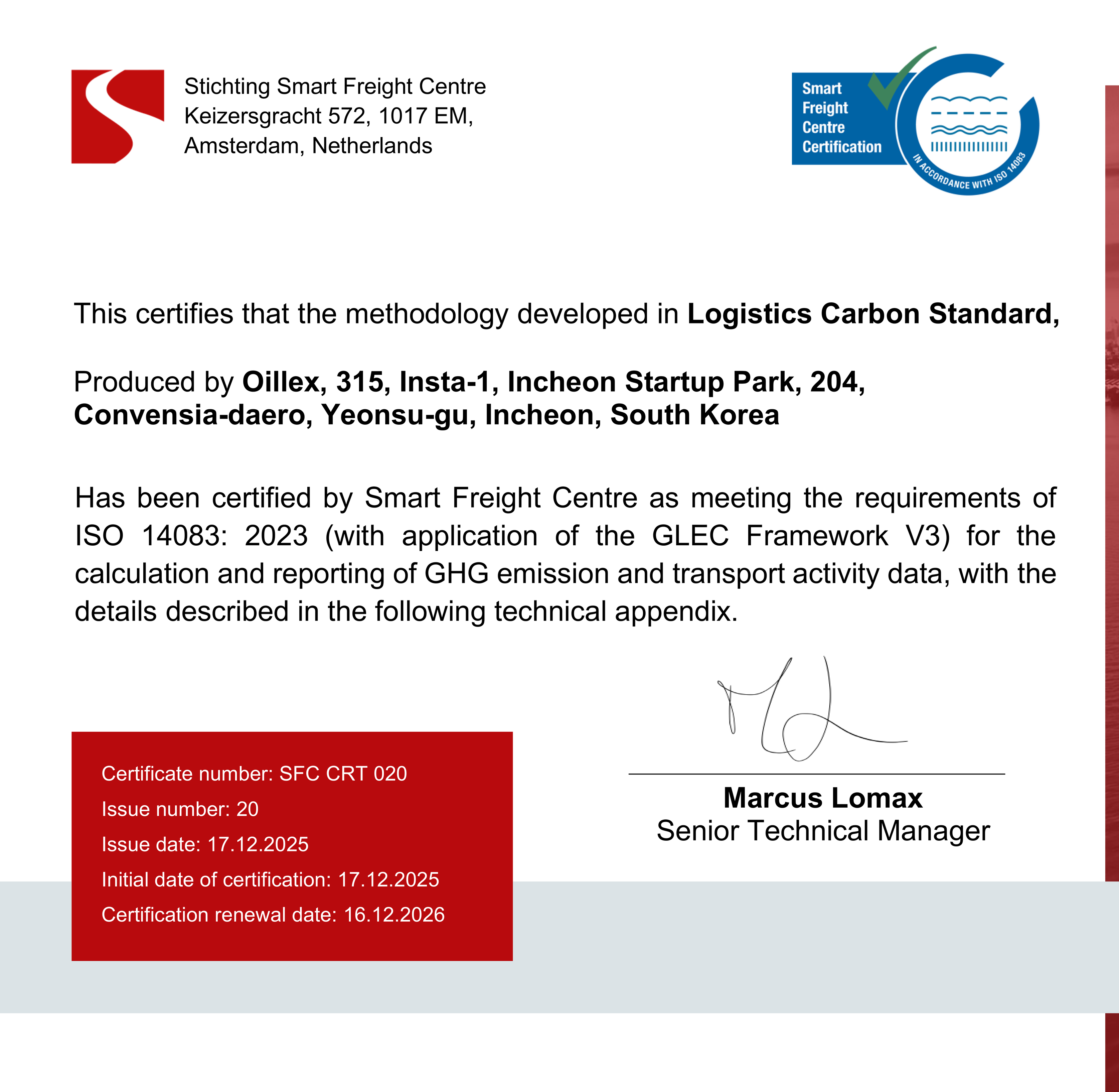
LTS’s carbon calculation is certified by Smart Freight Centre against ISO 14083:2023 and the GLEC Framework (CRT 020 · December 17, 2025).
LTS AI DTG (then GLEC AI Tachograph) was named a CES 2026 Innovation Awards Honoree in Supply & Logistics.
LTS won the grand prize in the green logistics category at the 29th Korea Logistics Awards in May 2026.
Supporting documents
See the certificate, test results andapplication notices as originally issued
Partnerships
LTS works with the EACs registry and exchangeand with a Korean logistics alliance
LTS is the official agent of 123Carbon, the only EACs registry in the world.
LTS has a business cooperation agreement with Carboninsets, the only exchange for EACs.
LTS is a member of the Incheon Logistics AX Alliance.
Letter of support
123Carbon supports LTSas its partner in Korea

On behalf of 123Carbon B.V., I am writing to express our support for Logistics Tech Standard Inc. (LTS) as our partner in the Republic of Korea, and for our joint work to bring registry-backed Environmental Attribute Certificate Book & Claim system to the Korean transport systems.
- Korean measurement methodology and MRV data infrastructure — LTS
- Registry — 123Carbon
- Each issuance verified by an independent third party
- Deployment and support of the registry in Korea — LTS
History
Since its founding in 2022, LTS has builtlogistics standard technology step by step
Company founded as GLEC
TIPS R&D program of the Ministry of SMEs and Startups begins
Commendation from the Minister of Land, Infrastructure and Transport (33rd Logistics Day)
Named a CES 2026 Innovation Awards Honoree (Supply & Logistics)
Smart Freight Centre certification (CRT 020)
Exhibited at CES 2026
Confirmed as a women-owned business
Samsung Fire & Marine Insurance PoC
Business cooperation with 123Carbon and Carboninsets
Grand prize, green logistics category, 29th Korea Logistics Awards
Renamed from GLEC to LTS (Logistics Tech Standard Co., Ltd.)
Special award, star company category, 2026 Climate, Energy and Environment Startup Competition
LTS Cloud designated as a venture startup product on Venture Nara (Public Procurement Service)
Annual LTS Cloud supply contract signed with Hanjin
Member of the Incheon Logistics AX Alliance
Newsroom
LTS notices, press coverage and articles,all in one place
- Press로지스틱스테크스탠다드(LTS), 기후에너지환경창업대전 스타기업 부문 특별상2026.09.11 · 전자신문
- Articles"You may not assume it is absent"
There is a sentence in the standard under which "our transport emissions are probably not large" does not hold. To say it is not there, you have to measure and then say so.
2026.08.10 - ArticlesOnce significant, it falls inside the assurance scope
The provision setting the assurance scope names "emissions from significant emissions-intensive activities". And tying several categories into one target requires a consistent metric.
2026.08.10 - ArticlesTransport may be counted across categories 4 and 9 together
The 5% threshold is judged irrespective of category. Transport emissions split across upstream and downstream may miss it separately and clear it combined.
2026.08.10
Resources
Download the reports and guidespublished by LTS
- Transport Is an Activity the Standard Names
Before setting a target, the SBTi Corporate Net-Zero Standard V2.0 requires identifying and quantifying the emissions-intensive activities in a value chain. One of the three groups on that list is transport — road, rail freight, shipping and aviation, each with a NACE code and a boundary running from fuel production to combustion. Being on the list brings consequences: absence may not be assumed without analysis, 5% of Scope 3 makes it significant, and significant activities fall inside third-party assurance. For transport there is one decisive clause — emissions split across categories 4 and 9 may be aggregated.
PDF · 2026.08.10Request to download → - Where CDP Puts Transport
CDP is not a standard but a questionnaire and a scoring system, so which categories it treats as relevant decides what companies calculate. Its technical note on Scope 3 relevance by sector draws that map for 16 high-impact sectors. Upstream transportation is the largest slice of the transport services sector’s Scope 3 at 32%, while business travel and commuting average 0.10% and 0.20%. This report sets out the map and notes two category names swapped in that section’s own summary table.
PDF · 2026.08.10Request to download → - Two Standards Become One
On 29 July 2026 GHG Protocol announced that its Scope 1, 2, 3 and AMI standards will be brought together with ISO 14064-1 into a single co-branded corporate standard, with public consultation scheduled for the second quarter of 2027. What has to change now is nothing — the existing standards remain in effect until the new one is published. But the proposal has emissions reported in three separate parts, and the middle one is emissions tied to commodity certificates.
PDF · 2026.08.10Request to download → - Different Schemes, Different Shares
For the same biomethane guarantees of origin, the average certificate price covered 27% of production cost in the UK, 55% in Germany and 83% in Denmark. This report goes to the primary sources in each country to find where that difference comes from. The answer is that the obligation schemes count different things — volume in the UK, a reduction percentage in Germany, one fuel pair in Korea — and Denmark is mid-transition from subsidy to tender. Where the scheme differs, what the certificate has to carry differs with it.
PDF · 2026.08.10Request to download → - Who Vouches for It
The question left at the end of any certificate review is trust: who vouches for the fact that this points at a real reduction? The answer is that verification is not an audit of a certificate already issued — it is a precondition of issuing one. Working from the published announcements of 123Carbon, SCS Global Services, DP World and the SBTi standard, this report sets out where verification actually sits, which bodies keep appearing, and what has to exist before any of it applies.
PDF · 2026.08.10Request to download → - How the Price Is Set
The second question about emission certificates is always "how much?". There is no published price index for transport insetting certificates, so that question has no answer — but where the price comes from, and what has actually changed hands, are visible in published material. Working from primary sources — a $200 million aviation contract and an inset programme running at a UK port — this report keeps the figures that were published strictly apart from the figures obtained by dividing them.
PDF · 2026.08.10Request to download →